

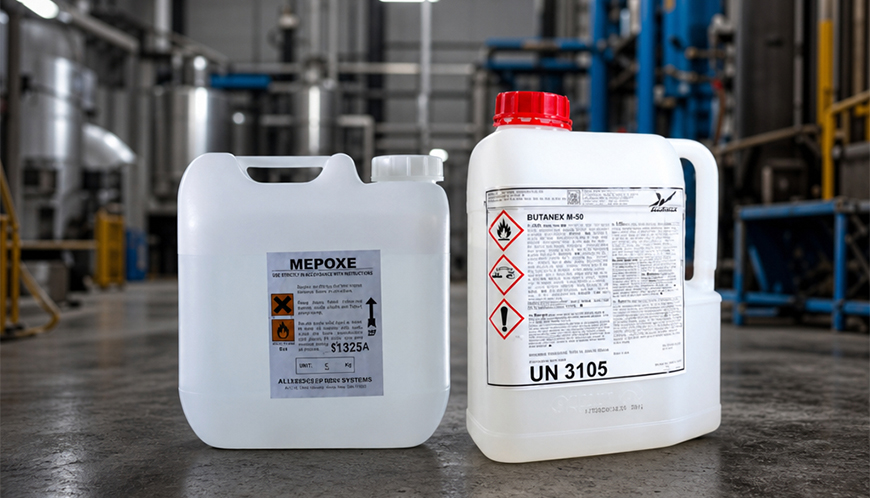
Polychem Middle East supplies high-purity peroxide catalysts for the curing of unsaturated polyester and vinyl ester resin systems. Our catalyst range includes MEPOXE (general and premium options) and BUTANOX (M50 and LPT) — industry-standard methyl ethyl ketone peroxide (MEKP) formulations widely used in GRP hand lay-up, spray-up, resin transfer, and continuous lamination processes.
Correct catalyst selection and dosage is critical for achieving consistent gel times, complete through-cure, and optimal mechanical properties in GRP laminates. Our technical team can advise on the correct catalyst for your specific resin, temperature, and application requirements.
Our Products
Our catalyst range covers general lamination, premium gelcoat systems, and low-exotherm formulations for thick sections. Download the Technical Data Sheet for each product below.
MEPOXE
Standard MEKP catalyst for general purpose polyester and vinyl ester resin lamination. Provides reliable gel time control and consistent through-cure for hand lay-up, spray-up, and continuous GRP production processes.
Download TDSMEPOXE M
High-purity, premium-grade MEKP catalyst specifically formulated for gelcoat and vinylester resin applications. Delivers low residue, minimal colour impact, and excellent surface quality — ideal for cosmetically critical GRP parts.
Download TDSBUTANOX M50 / LPT
Industry-standard methyl ethyl ketone peroxide (MEKP) catalyst range. M50 is the general-purpose formulation for GRP production; LPT is a low-peak-temperature variant for thick laminate sections where heat control is critical.
Download TDSProduct Range
We supply catalysts suitable for a wide range of polyester and vinyl ester applications — from fast gel-time systems for production-line efficiency to controlled-cure formulations for thick sections and complex geometries.
- MEPOXE General — standard MEKP catalyst for polyester and vinyl ester resins
- MEPOXE Premium — high-purity, low-impurity catalyst for critical applications
- BUTANOX M50 — widely used industry-standard MEKP for GRP production
- BUTANOX LPT — low-peak temperature formulation for thick sections
- Typical usage: 1–2% by weight of resin depending on temperature and gel time
- Compatible with cobalt-accelerated polyester, vinyl ester, and dicyclopentadiene (DCPD) resins
About Catalyst
Catalyst is a crucial component used in the curing process of polyester and vinylester resins. As a hardener or catalyst, it plays a vital role in initiating and speeding up the chemical reaction that transforms the liquid resin into a solid, durable material. Typically, CATALYST is a solution of organic peroxides, most commonly methyl ethyl ketone peroxide (MEKP), which, when mixed with the resin, activates its polymerization process.
This hardener is essential in industries such as marine, automotive, construction, and manufacturing, where polyester and vinylester resins are commonly used for making composite materials, laminates, and various reinforced plastic products. By controlling the amount of CATALYST used, manufacturers can adjust the cure time and hardness of the final product, allowing for customized properties suited to specific applications.
Initiates Curing
MEKP activates the polymerization process in polyester and vinylester resins, converting liquid resin into a rigid, load-bearing solid.
Adjustable Cure Time
Controlling the catalyst dosage allows manufacturers to fine-tune gel time and cure speed to match production requirements and ambient temperature.
Organic Peroxide
MEKP-based catalysts are solutions of organic peroxides that react with cobalt accelerators to trigger and sustain the cross-linking reaction in resin systems.
Marine & Automotive
Widely used in boat hull construction, automotive body parts, and structural GRP components requiring consistent and reliable curing performance.
Construction & Manufacturing
Essential for GRP panels, pipes, tanks, and industrial laminates produced in the construction and manufacturing sectors across the region.
Customised Properties
By varying catalyst dosage and grade, the hardness, cure speed, and mechanical profile of the final composite can be precisely tailored to each application.
Technical Guidance
In the UAE's hot climate, lower catalyst percentages (1.0–1.5%) are typically used to maintain adequate working time. BUTANOX LPT is particularly recommended for thick GRP sections where peak exothermal temperature must be controlled to prevent cracking. Always store catalysts separately from accelerators — mixing undiluted cobalt with undiluted MEKP is a fire and explosion hazard.
Controlled Cure
Achieve consistent gel times and through-cure across varying temperatures with our range of MEKP catalyst formulations.
High Purity
MEPOXE Premium grade offers low residue, consistent activity, and minimal impact on final laminate colour and properties.
Safe Handling
Supplied with full safety datasheets and storage guidance — never mix undiluted catalyst with undiluted accelerator directly.
Frequently Asked Questions
In temperatures above 30°C, use 1.0–1.5% MEKP by weight of resin. In cooler conditions (15–20°C), 2.0–2.5% may be required. Always perform a small-scale gel test before committing to full production batches.
Butanox M50 is the standard MEKP for general GRP use. Butanox LPT is a modified formulation generating a lower peak exothermal temperature during cure — important for thick laminates (>10mm) where heat build-up can cause cracking or premature cure.
No. MEKP-based catalysts like MEPOXE and Butanox are only suitable for unsaturated polyester and vinyl ester resins. Epoxy resins require amine or anhydride hardeners. Using MEKP in epoxy systems will not produce a cure and may create hazardous conditions.